
In short
An atmospheric image and a photograph of a specific place do different jobs. Destination mood, season, time of day, and familiar travel scenes can be built without a trip. A particular hotel-room view, restaurant frontage, or anything someone chooses and pays for based on the photograph must be shot on location.
Travel content follows a schedule that rarely matches a shoot. A ski-season article is needed in early autumn, a blossom guide a month before the flowers open, and a “where to go in winter” feature is laid out in summer. A trip for six blog images rarely pays off either. Here is how to close that gap without misleading the reader.
Where is the line between atmosphere and a promise?
Atmosphere conveys a mood and type of place: a mountain road at dawn, a summer coast, a winter city, or a spice market. A promise points to the specific thing someone will choose and pay for: this hotel, this room, this window view, this restaurant.
A generated image can honestly do the first job because the reader takes in the mood, not an address. It can never do the second. A sales image of a property has a documentary role. Booking services and aggregators set their own rules for authentic property photography, so check the relevant platform; “close enough” does not count here.
What makes a travel image look credible?
Travel credibility rests on details a local notices immediately and an editor in another country may miss.
Travel image credibility checklist
- Match vegetation to the climate; do not mix palms, conifers, steppe, and tropics.
- Keep architecture and materials plausible for the region, including roofs, windows, fences, and walls.
- Make transport and road markings agree with the location: traffic side, buses, and signs.
- Dress people for the place and season.
- Avoid signs, shopfront lettering, and other text, where models produce convincing nonsense.
- Match light and shadows to the stated time of day and latitude.
- Do not use a recognisable landmark with an “almost right” silhouette; everyone notices a distorted famous building.
- Never present the frame as documentary photography of a specific place or add a precise address caption.
How can you build a series rather than one image?
A series has four axes, and you need to decide all four before searching.
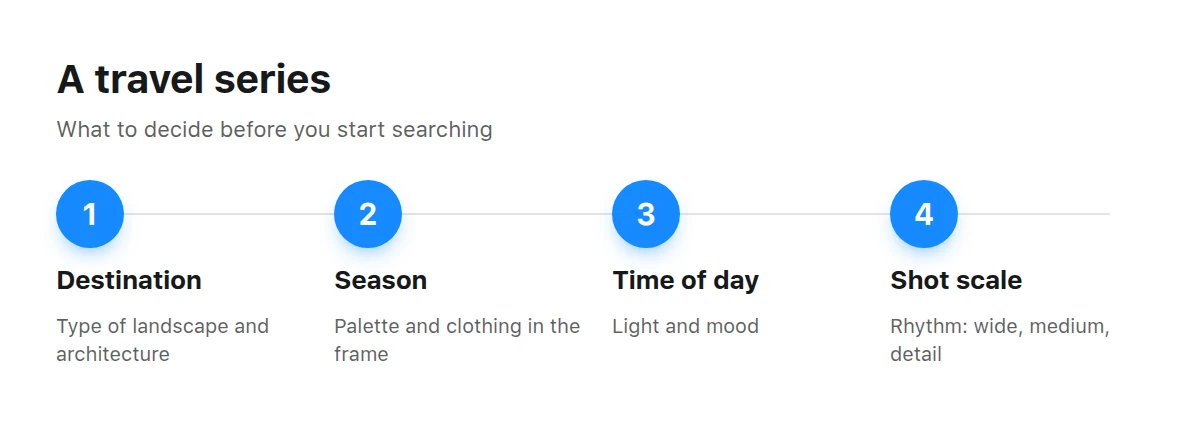
Four decisions before the search turn random finds into a set.
Destination sets the landscape and architecture; season controls palette and clothing; time of day establishes light and mood; shot scale creates rhythm. A story made entirely of wide midday shots feels even and dull. Moving between wide, medium, and detail shots creates the sensation of a journey.
For a six-image feature, a useful mix is one wide cover, two medium section images, two details — food, fabric, an unlettered sign, or water beside a boat — and one human image from behind or in motion. Tight portraits rarely help a travel collection: readers imagine themselves on the trip, and a stranger’s face in close-up gets in the way.
Which travel subjects are useful all year?
The most useful subjects are not tied to one point on a map but read instantly as travel. Keep them ready for stories without their own geography.
- The road. A hairpin bend, highway across the steppe, coastal train, or ferry. A road is a universal travel metaphor and an excellent text backdrop.
- Packing and luggage. A suitcase, documents, aircraft window, or check-in desk works for stories about preparation, insurance, and visas.
- A pause on the way. Coffee on a terrace, a bench with a view, or a rest along the route.
- The season itself. First snow, blossom, golden autumn, or summer heat. Seasonal features are prepared early, which is the main reason to generate travel visuals.
- Weather as the subject. Fog, rain on glass, or a coastal storm. Bad weather is rarely photographed for stock, but off-season stories need it.
What jobs can a ready-made image handle?
These are the five most common uses for travel visuals.
A blog or “where to go” guide
Use one cover and one image per section. Seasonality drives the schedule: the piece is laid out a month or two ahead, when a new shoot is already too late.
A travel agency’s email and social media
Atmospheric destination images for announcements. A consistent series makes the feed recognisable.
Destination websites and landing pages
Page heroes, section backgrounds, and search-form backdrops need quiet space for text.
A guidebook or printed piece
Chapter dividers and backgrounds. Resolution matters here because print needs extra pixels along the longest side.
Service and app design
Section illustrations, empty states, and card backgrounds. The exact subject is secondary; consistency comes first.
How should you handle people and recognisable objects?
People in travel images provide scale and presence, not portraits. A figure on a trail, silhouette by the water, or back turned in a market crowd works best. The less identifiable the face, the fewer questions about who is shown.
Objects are more complicated. A famous building, amusement park, museum, or bridge may be protected as a trademark or subject to commercial image-use restrictions, which vary by country. In practice, avoid recognisable landmarks and branded design in advertising. If the story cannot work without them, ask the rights holder about the terms.
Signs, menus, and directions need special attention too. Generated text tends to be meaningless and can make an ad look as though it depicts a real business. The easiest answer is to choose a frame with no writing at all.
TravelTravel: roads, transport, scenes in transit, and destination views.
Nature: mountains, coasts, forests, and fields — the basis of any travel piece.
City: streets, waterfronts, neighbourhoods, and urban life.
Architecture: buildings, façades, and details that shape the identity of a place.
If the destination is missing, browse the full catalogue; search covers titles and descriptions.
Where is a generated travel image better or worse than a shoot?
Each approach has its own territory, and they compete less often than it seems.
Generation wins
- Season and weather on demand rather than by the calendar
- One consistent series for the whole story
- Wide shots and familiar scenes on the road
- Destinations where a crew will not travel for six images
- Backgrounds and backdrops for text
Photography is essential
- A specific hotel, room, restaurant, or property
- Documentary reporting and news
- People identified by name
- Anything someone buys based on the photograph
How should you caption a travel image without misleading readers?
The caption can matter more than the image. The same frame can be an honest illustration or a deception depending entirely on the words beside it.
Three rules prevent most problems:
- Do not name a place the image does not show. “The Adriatic coast” beneath a composite scene is a claim; “Mediterranean coast in summer” describes a mood.
- Do not caption an image as reportage. A date, event, and person’s name turn an illustration into purported evidence.
- State the nature of the image where readers make a decision. In a “where to go in March” article, one word — “illustration” — preserves a great deal of trust.
What can you do if the destination you need is missing?
Build it yourself. Travel contains infinitely more subjects than ready-made images, and the exact combination of season, time of day, and type of place almost always needs to be created for the brief.
Related reading: marketplace image requirements, the visual set for a technology product, and business images without clichés.
Can a generated image be used in a travel blog?
Yes, when it illustrates mood, a type of place, or a season rather than posing as a documentary photograph of a specific location. The label “illustration” removes ambiguity in borderline cases.
What about an advert for a tour or hotel?
Use generated imagery only for backgrounds and design. Anything showing the property being sold must be authentic photography, as both common sense and the relevant booking platform’s rules demand.
How can you avoid a generic “nowhere” image?
Specify terrain, building materials, vegetation, and season. Without those signals, a frame may look pretty but remain forgettable.
What most often gives away a generated travel image?
Nonsense on signs, distorted silhouettes of famous buildings, light that conflicts with the stated time of day, and vegetation from the wrong climate.
Must you say that the image was generated?
There is no universal rule for blogs, but an honest label builds trust when a reader is making a travel decision. Check the requirements of the publishing platform too.
How can you build one series for an article covering several countries?
Keep light and shot scale consistent, while changing landscape and architecture between destinations. The result feels like one feature rather than five unrelated ones.