In short
In beauty and wellness, an image is almost always read as a promise. That creates separate rule sets: flexible ones for atmosphere, care rituals, and textures, and strict ones for anything resembling a treatment result or medical claim. Advertising platforms restrict before-and-after imagery, while promotions for medical services face additional requirements.
Why are visuals riskier in beauty than in other industries?
Because the image does not merely illustrate here; it makes a promise. A shot of flawless skin beside a serum name reads as “you will look like this,” even when the copy says nothing of the kind. Both advertising-platform reviewers and authorities assess that implied message.
The audience is another reason. Content about appearance and health touches personal concerns, so platforms have long treated it as a distinct area. Its advertising rules are stricter than those for furniture or food delivery, and some formats are prohibited altogether.
This does not mean using fewer visuals. It means separating them by purpose. Atmosphere, products, processes, and care rituals are relatively flexible territory. Treatment outcomes, diagnoses, before-and-after comparisons, and any promises belong to territory where rules come before the image.
Where do salons, brands, and clinics need images?
Most everyday needs sit within the flexible zone and can be covered with ready-made images.
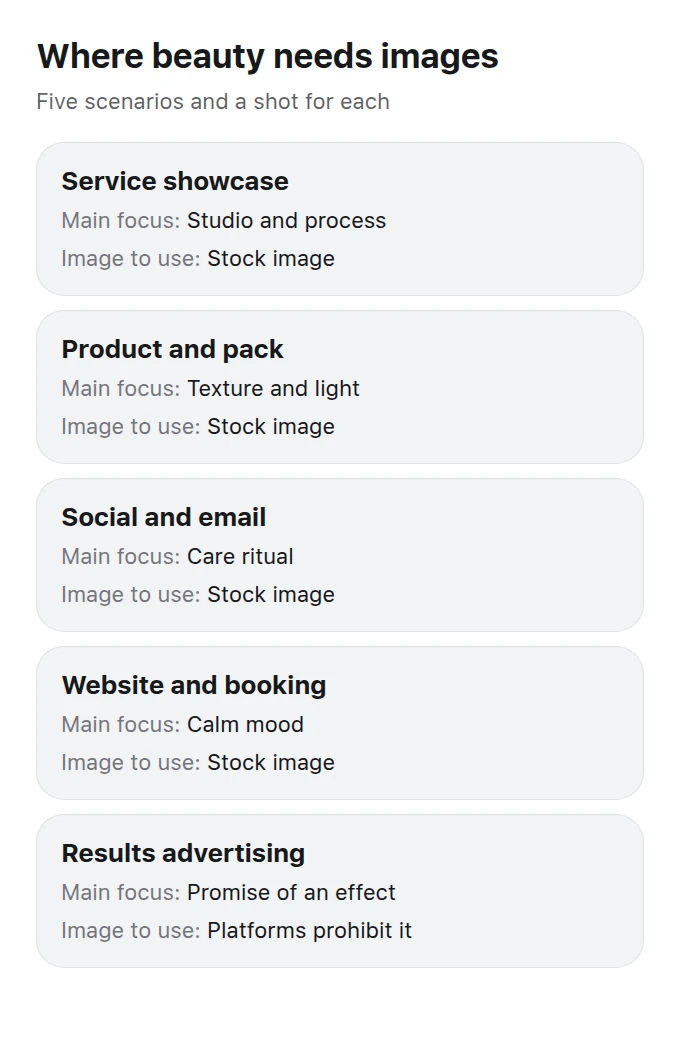
Five common scenarios: the further an image is from promising an outcome, the more freely it can generally be used.
Service menu and pricing. Show the mood and cleanliness of the treatment room, tools, and a professional’s hands at work, without client faces or outcomes.
Product and packaging. Use textures, drops, cream swatches, glass, and light. Ready-made images work especially well here because they are not tied to any individual.
Social media and newsletters. Care rituals, mornings, exercise, water, and sleep. This content is published frequently, and arranging a new shoot for every post is rarely cost-effective.
Website and booking. Hero areas, service sections, booking-form backgrounds, and professional profile pages.
Premises and print materials. Treatment-room posters, printed collateral, and signage need a large, simple subject without tiny details.
What do advertising platforms prohibit showing?
Before-and-after images and depictions of unexpected or unlikely results are restricted. This requirement appears in Meta’s advertising standards for health and appearance, within its Advertising Standards. The standards also restrict imagery that focuses on an isolated body part or encourages a negative perception of one’s own body.
Google has separate limitations. Health and medical topics are covered by its Healthcare and medicines policy. Depending on the country where an ad appears, some advertisers need certification and some content is prohibited altogether.
The practical implication for imagery is simple: do not present an outcome as a fact. Show the process, product, atmosphere, and practitioner at work instead.
What is almost always a problem
Before-and-after images. Close-ups of a perceived problem area. Captions such as “lose 5 kg” or “gets rid of acne.” Images that make an outcome look guaranteed. People in white coats posing as doctors beside a promise. References to diagnoses and symptoms.
What is usually safer
Product textures and swatches. Tools and a clean workspace. A professional’s hands during a procedure. A calm portrait without emphasis on a “flaw.” A care ritual with water, a towel, and morning light. Packaging and glass.
How can you show people when you cannot show results?
Show process and emotional state rather than comparison. An image of someone feeling comfortable can work as well as a before-and-after pair without creating the same concerns.
Several approaches commonly fare better in review:
- A portrait without focus on a problem. A calm face, natural light, and no extreme close-up of the skin.
- A procedure from the professional’s viewpoint. Hands, tools, and precision communicate expertise more effectively than a claimed outcome.
- A ritual. Morning, water, a towel, and a cup of tea create an association with care rather than correcting a defect.
- A product in close-up. Use texture and packaging instead of a face.
- Abstraction. Color, light, and form suit banners and covers where the copy carries the primary meaning.
How can you pass moderation on the first attempt?
Prepare the image and copy as a single unit rather than reviewing them separately. Moderators assess an ad as one message: a neutral image beside a promise to “erase wrinkles” can be rejected just as readily as a before-and-after comparison with cautious wording. Check the complete combination before the creative is uploaded to the ad platform.
A simple rehearsal helps: read the headline aloud while looking at the image, then ask what exactly the ad promises the viewer. If the answer sounds like “this will give you this result,” change either the visual or the wording. If it sounds like “this is how the treatment works” or “this is what the product is,” the concept is generally on safer ground.
It is also worth maintaining an internal list of prohibited words and visual themes for everyone preparing creatives: guarantees, diagnoses, efficacy percentages, and close-ups of perceived problem areas. A shared list prevents weeks of back-and-forth with platform support and stops questionable material before it reaches publication.
How should you prepare a brief for a sensitive topic?
Define what the image promises
If your one-sentence description becomes “after this, you will look like that,” the concept needs to change.
Remove the comparison
Do not place two states in one frame and do not add arrows. Use one state and one mood.
Describe light and materials
Choose soft, diffused light, glass, water, ceramic, and a towel. Materials and lighting create the sense of cleanliness that the image is meant to convey.
Check the adjacent copy
An image is reviewed together with its caption. “Radiant skin” and “removes pigmentation” are different claims to a reviewer, even when paired with the same picture.
Pre-publication checklist
- The material contains no before-and-after frames or other comparisons of results.
- There are no close-ups of perceived problem areas or emphasis on body parts.
- Adjacent copy does not promise an outcome, guarantee an effect, or cite individual recoveries.
- There are no images imitating a doctor or medical recommendation unless you operate as a clinic.
- Any warning required for medical-service advertising has been prepared.
- You checked the rules of the specific platform where the material will appear, rather than relying on general assumptions.
- Generated images are not presented as photographs of clients.
- Claims about ingredients and product properties are supported by the manufacturer’s documentation.
Which catalog categories should you browse?
BeautyCare, textures, tools, and rituals make this the main category for salons and cosmetics brands.
Exercise, sleep, water, and calm medical scenes without diagnoses or promises.
Everyday life and mood: mornings, self-care, and daily scenes for social media and newsletters.
Related categories include People for portraits and Fashion for style-led shoots. See the complete selection in the catalog.
What should you read next?
If you run a salon or treatment room, read our guide to visuals for interiors: in beauty, the space can sell as strongly as the service itself. If your work involves nutrition and benefit claims, see food images for restaurants and delivery, which explores the same boundary between atmosphere and promise.
What are the frequently asked questions?
Can before-and-after images appear in a regular post rather than an ad?
Platform policies are written primarily for advertising, but an organic post may still face restrictions, and readers will still interpret it as a promise. Building content around process and testimonials is safer than relying on a pair of comparison images.
Is a generated face suitable for a service showcase?
Yes, provided it is not presented as a client or used to illustrate a result. An image without a real person resolves the model-consent issue, but it does not override content rules.
Do salon posts need a contraindication warning?
Such requirements generally concern advertising for medical services, medicines, and medical devices. A beauty treatment room or salon may fall within this area depending on its service list, licensing, and local rules, so seek legal advice.
What should you do if reviewers reject an ad?
Read the reason and revise the specific element. Common triggers include focus on a body part, a promise in the headline, or restricted wording. Replacing the image without correcting the copy usually does not help.
Can you say that a product is “clinically proven”?
Only when you have supporting documents and they apply to that exact product. Otherwise, it is a claim you may be required to substantiate both to the platform and to relevant authorities.
What should you do with client testimonials that include result photos?
A testimonial does not override platform rules: if the images read as before and after, they remain prohibited in advertising. In your own channels, publish the testimonial with the person’s consent and without comparison images, and describe the result in words instead.
How can you show a clinic without breaking the rules?
Focus on the space, equipment, staff, and process. It is better to remove diagnoses, symptoms, and treatment outcomes from the visuals altogether.
Can these images be used by pharmacies and on marketplaces?
The license covers commercial use, but each marketplace or advertising service sets its own rules for listings and ads. Healthcare and pharmacy categories are usually reviewed more strictly, so check the relevant service requirements before preparing layouts.